Hey everyone, I’m here to break down the concept of Kaizen. It’s a Japanese idea that’s all about making things better, little by little, all the time. The word “Kaizen” itself means “change for the better”. It’s about constantly improving, and it’s something everyone can do. It’s not just for big companies; it’s for everyone who wants to make things better. So, let’s get started and see what Kaizen is all about!
What Exactly is Kaizen?
So, what is this thing called Kaizen? Well, it’s like having a superpower that helps you improve stuff. It’s both a way of thinking and a way of doing. It’s like having a secret recipe for making things awesome!
- Action Plan: Think of Kaizen as a set of steps you take to fix or improve something. For example, if something is broken, or there’s a process that’s too slow, you make a plan to fix it.
- Philosophy: It’s also a way of thinking where you always look for ways to make things better. It’s like having a growth mindset, where you believe you can always learn and improve.
Kaizen also believes that everyone in a team can help. It’s like having a bunch of superheroes, each with their own amazing talent, working together to make things better. And it’s not about making big changes all at once; it’s about making small changes that add up to big results over time. Anyone can come up with ideas to make things better, and that’s a core part of Kaizen.
Now it’s important to understand that there is a big difference between change and improvement. A change is just something that is different. It may or may not be better. With Kaizen, we want to make changes that are improvements.
The Real Meaning of “Kaizen”
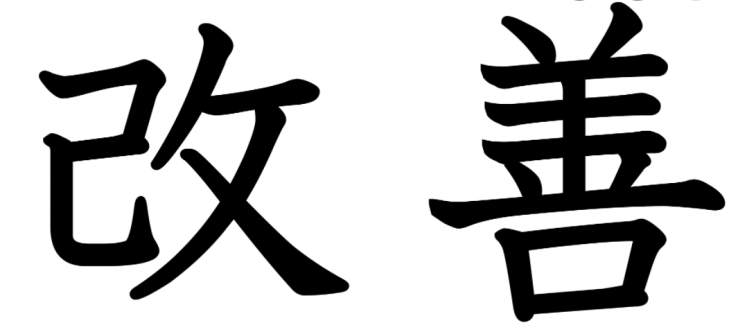
Kaizen, often translated as “continuous improvement,” is a Japanese business philosophy and practice focused on making small, incremental changes over time to improve processes and systems, with an emphasis on the involvement of all employees. Let’s take a closer look at the word “Kaizen”. In Japanese, it’s made up of two parts:
- Kai 改 (change)
- Zen 善 (good)
But, there’s a deeper meaning to these words. “Kai” can also mean self-discipline or self-whip. It’s about having the self-control to change yourself. “Zen” means sacrifice for the good. So, Kaizen is really about changing yourself, having the discipline to whip yourself to change for the better, and making sacrifices for the good of the whole team.
Now, here’s something interesting: while we often use Kaizen to mean “continuous improvement”, the real Japanese word for continuous improvement is actually “Kairyo 改良”. So, Kaizen is more about internal reflection, and Kairyo is more about external improvements. It is a practice of personal accountability and continuous self-betterment, alongside improvement to workplace processes. The output of this internal Kaizen is the foundation of external, continuous improvement or Kairyo. With Kaizen, you look at your own actions and see how you can do better, and with Kairyo, you look at the process, and try to improve it.
How did Kaizen originate and become popularized?
The concept of Kaizen began taking shape in Japan after World War II, with influences from American quality control experts like W. Edwards Deming. Deming went to Japan in 1947 to teach his approach of statistical process control, focusing on quality at every stage. Kaizen was then developed as part of the Toyota Production System (TPS), which focuses on just-in-time manufacturing. Masaaki Imai popularized the term in the West with his 1986 book “Kaizen: The Key to Japan’s Competitive Success,” showcasing its importance in long-term competitive strategy. The small-step work improvement approach was developed in the USA under the Training Within Industry program (TWI Job Methods) during WW2, and introduced to Japan by American occupation forces.
What are the different types or levels of Kaizen?
Kaizen can be implemented at different levels within an organization:
- Point Kaizen: Quick, immediate fixes to isolated issues, often done without much planning. For example, a shop inspection by a supervisor who sees a broken object and asks for the team to do a quick 5S to rectify the situation.
- System Kaizen: Organized, strategic planning to address system-level problems within the organization. It can be thought of as an upper-level strategic planning method for a short period.
- Line Kaizen: Improvements focused on the communication between upstream and downstream processes within a particular line.
- Plane Kaizen: Connecting and implementing improvements across several lines or value streams, which might span traditional department boundaries and can be seen as a value stream where organization is structured into product lines and families.
- Cube Kaizen: Connecting all points across all planes, involving the complete organization, suppliers, and customers, which might require changes in standard processes and is the full expansion of lean across the enterprise.
What are the core principles and methodologies of Kaizen?
Kaizen is guided by several key principles:
- Customer Focus: Prioritizing customer needs and value in all improvements.
- Waste Elimination: Identifying and removing any activity that doesn’t add value, categorized into the “seven muda” (waste).
- Genba (Go to the Source): Directly observing processes at the place where work is done to understand the problems and develop solutions. This includes going to the factory floor in manufacturing, and gathering data from all sources on site.
- Empowerment: Enabling employees at all levels to participate in the improvement process. Those who perform the work are empowered to identify problems and implement changes.
- Transparency: Open communication and sharing of information about processes and changes.
- Continuous Improvement: The recognition that there is no perfect end and that there are always ways to make processes, systems, and oneself better.
- PDCA Cycle: A framework for improvement that includes planning, doing, checking, and acting/adjusting.
- Standardized Work: Establishment of a stable process baseline before making improvements, allowing gains to be measured and standardized as part of continuous improvement and preventing them from disappearing over time. It acts as living documentation that is continually updated through Kaizen.
What are the key benefits and potential challenges of implementing Kaizen?
Kaizen provides many benefits, including:
- Increased productivity and efficiency
- Reduced waste (time, materials, resources)
- Improved product and service quality
- Enhanced safety
- Lower operational costs
- Better resource management
- Increased customer satisfaction
- Improved cooperation and communication among employees
- Higher employee satisfaction, engagement and morale
Potential challenges include:
- Thinking and focusing on kaizen as an event rather than actual improvements.
- Losing gains made during improvements because workers go back to previous methods.
- Failing to involve frontline workers in improvement activities.
- Having specialized engineers from outside day-to-day operations lead improvement efforts over those who do the work on the front lines.
How does Kaizen relate to standardized work?
Kaizen and standardized work are deeply interconnected. Standardized work creates a baseline for improvement. By using standardized work as a starting point, organizations can track improvements made with kaizen. Once a change improves something, the new method is standardized. This way, gains don’t disappear. Kaizen is a foundational aspect of lean manufacturing, where the goal is production without waste by standardizing and improving processes. Kaizen also works closely with the Just-In-Time inventory system, aiming to minimize excess inventory and improve efficiency. In order to achieve a JIT system, kanban systems are often used alongside it to provide visual cues that allow people to know when parts and materials need to be ordered, ensuring the smooth running of factory assembly lines.
There is also a 5S method that goes along with Kaizen:
- Seiketsu (Standardize): Make 5S a habit
- Seiso (Spotless): Keep everything clean and free of waste
- Seiri (Sort): Get rid of stuff you don’t need
- Seiton (Set in Order): Put everything in its place
- Shitsuke (Self-Discipline): Keep doing the 5S process
To help with improvement, Kaizen has a few checklists. There is the 7M checklist, which is also called the Ishikawa diagram. It helps you look at the key factors in your process. The 7Ms are:
- Man
- Machine
- Material
- Method
- Milieu (Environment)
- Management
- Measurability
There is also the 7W checklist. These help you dig deeper and find root causes. They are:
- What is to be done?
- Who does it?
- Why do it?
- How is it done?
- When is it done?
- Where should it be done?
- Why is it not done differently?
Kaizen also looks at the Three Mu. These are all things we want to get rid of:
- Muda (waste)
- Mura (unevenness)
- Muri (overburden)
Muda is often broken down into the Seven Muda. These are all common causes of loss and they create a handy acronym so you can remember them. TIMWOOD, I remember this as the guy who is trying to ruin my business is Tim Wood (Apologies if that is your real name):
- Moving stuff around too much (Transportation)
- Having too much inventory (Inventory)
- Moving too much (Motion)
- Waiting too long (Waiting)
- Making too much stuff (Overproduction)
- Over-processing things (Over-processing)
- Making mistakes (Defects)
And finally, Genba Walks are a great way to understand what is actually going on. Remember to go to the place where the work happens to see the problems yourself don’t just look at data and think you know the whole story. There are 5 Genba principles you should always follow:
- Go to Genba first when a problem arises.
- Check the actual things involved (machines, rejects).
- Take a temporary action immediately.
- Figure out why it happened.
- Make it standard so it doesn’t happen again.
Kaizen and Friends
Kaizen has a lot of friends and other methodologies that work hand-in-hand:
- Lean Manufacturing: Kaizen is a big part of Lean, which aims to reduce waste in production.
- Six Sigma: This is another method that helps improve quality control.
- Theory of Constraints: This is a method that helps maximize flow through bottlenecks
- Just-in-Time (JIT): This is about making sure you only have the things you need when you need them.
- Kanban System: This helps manage inventory so that you can see when you need more materials or parts.
- Total Productive Maintenance (TPM): This helps monitor production lines.
- Kaikaku: While Kaizen focuses on continuous improvement, Kaikaku focuses on radical change, maybe this could be a topic for a different article.
How can Kaizen be applied in different contexts beyond manufacturing?
While often associated with manufacturing, Kaizen can be applied in diverse sectors:
- Healthcare: Improving patient care processes, staff communication, and efficiency.
- Hospitality: Enhancing customer service, streamlining operations, and improving the employee experience.
- Construction: Making jobs easier and safer for workers, while also improving efficiency.
- Agriculture: Optimizing farming processes, reducing waste, and increasing productivity.
- Administration: Streamlining workflows, improving communication, and reducing waste.
- Software Development: Enhancing processes and team communication, and improving overall development flow.
- Personal Development: Applying kaizen principles such as self-reflection, discipline and intention to personal habits and goals.
Wrapping Up
So, there you have it! Kaizen is a powerful way to make things better, whether it’s at work, school, or home. It’s all about always improving, involving everyone, and making small changes that lead to big results. It’s a never-ending journey of improvement! Now you know what Kaizen is, you can start using it in your life to make it even better!
I hope this was helpful and you now know all about Kaizen! If you’d like to dig deeper consider grabbing a copy of my new book Kaizen Mastery: https://amzn.to/3CXChge
 Steve Beauchamp