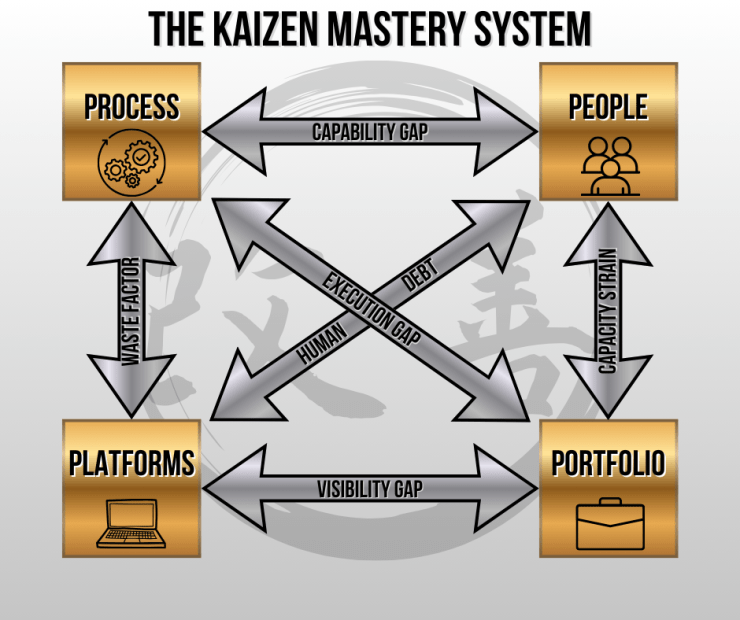
After completing the diagnostic assessment, if you have a severe deficiency between your Processes and Platforms, you will either discover that you have 1) The Analogue Burden: workflows are sophisticated and lean but unsupported by technology. Everything requires “manual orchestration” or 2) Automated Chaos: effectively, you have applied expensive technology to broken, chaotic processes, making mistakes much faster.
The Analogue Burden
If you find that your operations rely heavily on ‘heroics’ and spreadsheets, you may have complex logic in place but lack an efficient system to implement it. This situation creates a significant risk of having a single point of failure; if your key operators leave, your entire process could collapse. Additionally, without automation, you cannot scale your operations, as they demand too many “human-hours” to maintain.
Manual processes have their benefits, especially during the startup phase of a new product or service. They help determine whether your offering makes sense and if there’s genuine interest from potential users. However, many organizations stop at this stage, mistakenly believing that the manual process is the key to their success, often labeling it a “personal touch” or “concierge service.” This is only accurate if the tasks involved truly cannot be automated. In reality, by keeping processes manual, you may inadvertently undermine your team members’ value and growth potential.
Automated Chaos
The alternative issue you might be facing is the automation of dysfunction. I’ve lost count of how many times higher-level leadership has suggested that we simply need more software or to automate a spreadsheet or other manual tasks. The fundamental flaw in this thinking is a lack of understanding about whether we should be doing these tasks in the first place. Instead of using powerful technology wisely, we end up accelerating bad data and flawed logic faster than ever before. Your tech stack isn’t a lever; it’s an accelerant, and usually it accelerates operational waste.
Consider the work you do as if you’re digging holes. How often do you stop and ask yourself, “Is this where we should dig the hole? How deep should it be? What will the hole be used for? Is there another hole we could repurpose instead of digging a new one? Should we be digging a hole at all?”
The risk of automating processes without understanding their integrity is Systemic Instability. Automation without process integrity can lead to significant data errors and customer-facing failures. If you find yourself constantly stuck in traffic, complaining about the slow pace, simply having a faster car won’t solve the problem. Finding a new route, however, might change the dynamics entirely.
The Path Forward
If you find yourself nodding your head to either of these scenarios or any of the other scenarios from the other Friction Points, I would highly recommend that you take the 4 Pillar Pulse Check. This free assessment will help you identify which Pillar in your organization is lagging behind the others. Although this isn’t the full 37 Point Kaizen Mastery System Diagnostic Assessment, it will give you some insights. If you would like to discuss having a full Diagnostic Assessment and have me come work with you and your team in a Fractional Strategy & Optimization Advisory role, please reach out to me directly steve@stevebeauchamp.com.
 Steve Beauchamp