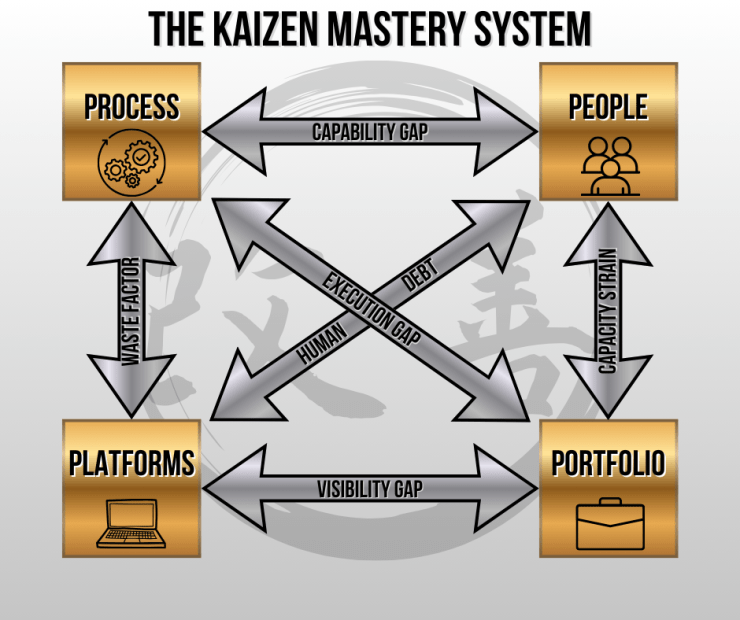
The fourth potential Friction Point that may emerge following the diagnostic assessment is known as the Capability Gap. This gap can manifest in one of two distinct ways. The first scenario is characterized by a Hero Culture, in which outstanding performers succeed despite systemic obstacles within the organization. In this environment, individual efforts often overshadow team capabilities, resulting in reliance on a few high achievers to carry the load for the entire organization.
The second scenario is referred to as the Bureaucratic Anchor. In this case, the organization has established intricate and sophisticated systems and processes; however, the current team lacks both the Kaizen Mindset—a commitment to continuous improvement—and the necessary skills to effectively implement and advance these systems. Consequently, the organization may find itself hindered by its own complexities, unable to harness its full potential for growth and innovation.
The Hero Culture Trap
When a Hero Culture becomes the norm, your organization becomes entirely dependent on ‘A-Players’ for survival, as your systems and workflow processes are lacking. Instead of having a cohesive business, you have merely a collection of talented individuals. This approach is unscalable and creates a ceiling that no amount of hiring can overcome. The risk of maintaining such an environment for an extended period is extreme burnout. When your “heroes” leave or become overwhelmed, the entire department can collapse because there are no systems in place to support them. This outcome is entirely preventable, and one of the simplest ways to quickly improve conditions within your organization.
The Bureaucratic Anchor
You may have realized that you’ve created a system that prioritizes mediocrity. Your processes are so rigid, and your talent development is so minimal, that your top performers feel restricted while your least efficient employees feel secure. You are focusing on compliance rather than performance. Continuing down this path carries the significant risk of achieving compliance without fostering growth. The procedure may be followed mechanically as a mere “tick-box” exercise, but this does not generate real value or improvement. Just because people adhere to the rules doesn’t mean you’ve achieved success. While it’s important to maintain compliance with regulations, it shouldn’t come at the cost of your organization’s growth. Striking a balance between compliance and development is essential.
The Path Forward
If you find yourself nodding your head to either of these scenarios or any of the other scenarios from the other Friction Points, I would highly recommend that you take the 4 Pillar Pulse Check. This free assessment will help you identify which Pillar in your organization is lagging behind the others. Although this isn’t the full 37 Point Kaizen Mastery System Diagnostic Assessment, it will give you some insights. If you would like to discuss having a full Diagnostic Assessment and have me come work with you and your team in a Fractional Strategy & Optimization Advisory role, please reach out to me directly steve@stevebeauchamp.com.
 Steve Beauchamp