
Most beverage manufacturers don’t stall because the founder lacks ambition. They stall because the business can’t carry the ambition without creating friction everywhere else. A new retail account lands, and suddenly production planning gets messy. A product launch pulls sales into long meetings. Quality checks live in spreadsheets. The best operators become human shock absorbers.
That pattern is expensive, even when nobody writes a check for it. Missed handoffs create downtime. Weak demand visibility leads to rushed changeovers. Too many active projects dilute attention. And the CEO ends up making decisions from partial information, usually after the problem has already spread.
I use the term structural drag for that condition. It’s the resistance built into the way the business operates. Growth exposes it. More volume, more SKUs, more channels, and more people don’t fix it. They put more weight on the same weak points.
Why beverage businesses feel growth friction so quickly
Beverage manufacturing has very little room for sloppy coordination. A production schedule depends on packaging availability, ingredient supply, labor, line capacity, quality release, warehouse space, and customer commitments. One late decision can move through the facility like a dropped bottle on a fast conveyor.
The tricky part is that many problems look like isolated operational issues. A late shipment appears to be a procurement problem. A missed production run looks like a scheduling problem. A founder working sixty-hour weeks looks like a temporary season of intensity.
Usually, those are symptoms. The deeper issue is a mismatch between four areas of the company:
- People: the skills, decision-making capacity, and available attention on the team.
- Process: the repeatable way work moves from decision to execution.
- Platforms: the systems, data, automation, and software supporting the work.
- Portfolio: the strategic commitments, products, customers, and growth initiatives competing for attention.
When those areas support one another, growth feels controlled. When they pull in different directions, every new opportunity carries a hidden tax.
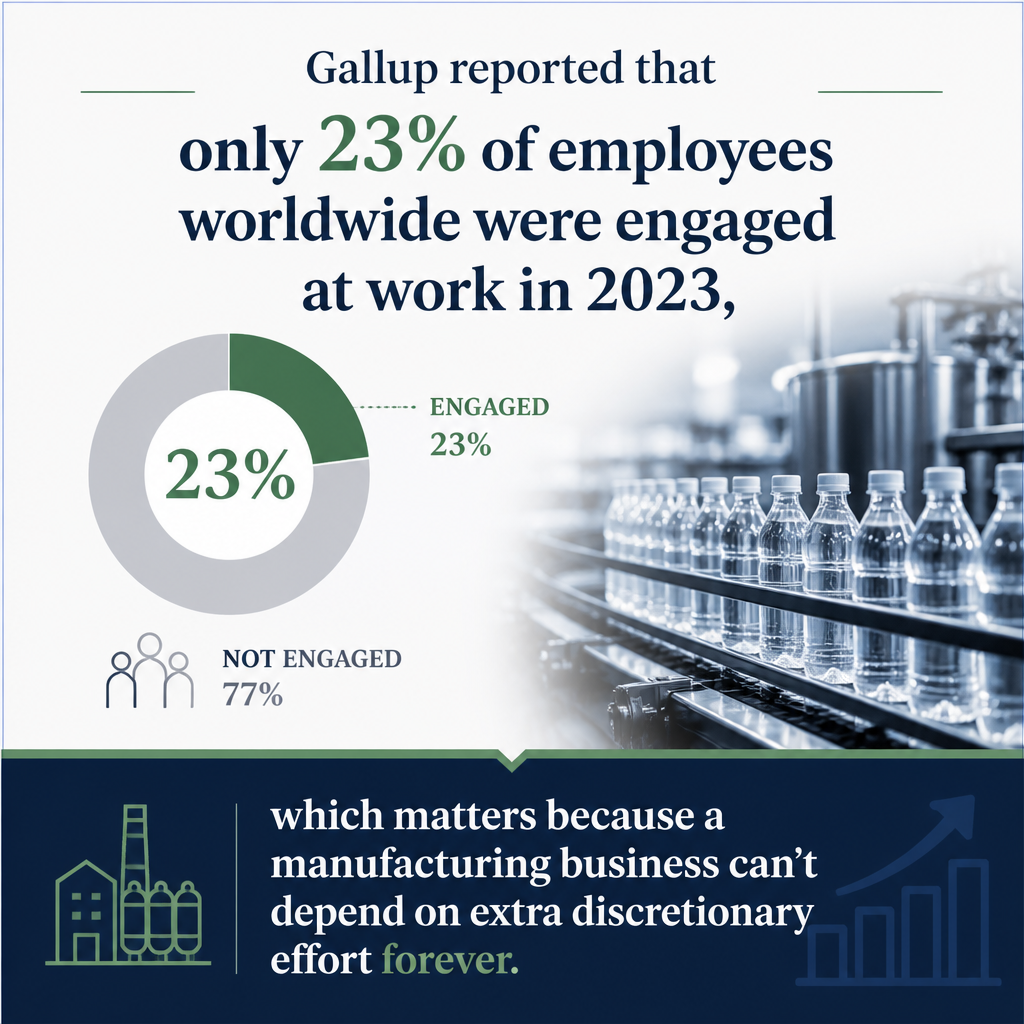
Gallup reported that only 23% of employees worldwide were engaged at work in 2023, which matters because a manufacturing business can’t depend on extra discretionary effort forever.
That’s especially true on a plant floor. You can ask people to rescue a difficult week. You can’t build a durable operating model around constant rescue work.
The six friction points that slow a beverage manufacturer down
When I assess a growing beverage company, I’m looking for tension between those four areas. Six recurring friction points tend to show up.
The execution gap
This is the distance between what leadership has decided and what the business can reliably deliver. The CEO wants three new channels, two new flavors, a co-packing relationship, and a stronger forecasting process. Operations has enough capacity for one major change without compromising current output.
That mismatch creates an initiative graveyard. Projects start with energy, then stall when daily production takes priority. Nobody is necessarily underperforming. The company simply committed to more work than its operating rhythm could absorb.
The opposite problem exists too. A team may run an efficient schedule while spending its energy on low-value work. Everything is tidy. Nobody is asking whether the work still supports the commercial strategy.
The human debt
Human debt appears when the company buys technology before fixing adoption, ownership, or decision rights. A new ERP system, planning tool, or quality platform gets installed. People receive a short training session. Then the old spreadsheets quietly return.
I saw this happen with a manufacturer that had invested in a production planning system but still printed the weekly schedule every Friday. The software wasn’t the real issue. Supervisors didn’t trust the data, planners weren’t clear on who could change the schedule, and no one had defined a standard review cadence.
The other side is just as costly. Skilled people spend hours entering the same information in multiple places. That manual tax drains attention from yield improvement, customer service, and root-cause work.
The waste factor
A sound workflow supported by weak tools becomes a manual obstacle course. A weak workflow supported by sophisticated software becomes faster chaos. Neither situation is fixed by buying another application.
Start with the work itself. How does a purchase order move from customer commitment to production release? Where does the specification live? Who approves a substitution? What happens when the actual run rate differs from the plan?
Those questions often uncover duplicate entry, unclear approval points, and information that exists only in one person’s inbox.
The capability gap
Many young beverage companies rely on exceptional operators who know every detail by memory. They can adjust a run, call a supplier, calm a customer, and fix a quality issue before lunch. That talent is valuable. It can also hide a fragile operating model.
When a key person takes vacation, leaves the company, or simply reaches capacity, the gaps become visible. The answer isn’t to remove judgment from the work. It’s to capture the repeatable parts so experienced people can focus on the exceptions.
The capacity strain
This is ambition measured against actual bandwidth. A team of three gets assigned ten meaningful goals. Meetings multiply. Important work gets pushed into evenings. The company calls it commitment, but the result is usually slower execution and higher turnover.
The U.S. Bureau of Labor Statistics reported that the median employee tenure was 3.9 years in January 2024, so relying on a few long-serving people to carry undocumented knowledge creates a real continuity risk.
Capacity needs to include more than headcount. It includes decision load, training time, changeover complexity, and the number of unresolved problems each leader is carrying.
The visibility gap
A CEO shouldn’t have to wait until month-end to learn that a high-volume SKU is slipping, a customer forecast changed, or a line is losing productive hours. Yet many manufacturers still run on lagging reports and informal updates.
Good visibility doesn’t mean tracking everything. It means identifying the few measures that help leadership make a better decision this week. Schedule adherence, yield, changeover time, order fill rate, inventory accuracy, and quality holds may matter more than a colorful dashboard with thirty metrics.
What business strategy looks like on the plant floor
Strategy often gets discussed as a market question. Which retailers should we pursue? Which products should we launch? Should we invest in our own facility? Those questions matter, but a strategy becomes real only when the operating system can carry it.
Say the company wants to expand into a national grocery account. The commercial upside may be attractive. The operating questions arrive immediately:
- Can the line produce the required volume at the promised service level?
- Can the team manage another packaging format?
- Will the customer’s forecast improve planning or create more volatility?
- Can quality release product quickly enough?
- Does working capital support the longer lead times and larger production runs?
That isn’t pessimism. It’s responsible strategy. A good opportunity can still be a bad commitment when the business lacks the capacity to deliver it consistently.
Research published by the Project Management Institute has found that organizations waste about 9.4% of every project dollar because of poor project performance, a useful reminder that unclear ownership and weak execution can consume value even after the strategic choice is sound.
For a beverage manufacturer, the practical move is to connect each strategic initiative to an accountable owner, a defined outcome, a capacity assumption, and a short review cycle. No decorative planning exercise. Just enough structure to expose trade-offs before they become operational emergencies.
How I diagnose the real source of friction
When working with clients on this, the first thing I check is not the software stack. I trace one important commitment through the business.
Take a new SKU launch. I ask where the decision started, who approved the formula, how demand was estimated, where packaging specifications were stored, how the first production date was chosen, and what information is available after the run. The handoffs tell me more than a long leadership interview.
My 37-point diagnostic measures the variance across people, process, platforms, and portfolio. The goal isn’t to produce a thick report. It’s to locate the primary rupture zone, the one source of friction creating the most downstream drag.
That distinction matters. A company may believe it needs better forecasting. The deeper issue might be that sales changes the forecast without a defined cut-off. Or operations may have reliable data, but nobody trusts the numbers because inventory transactions are inconsistent.
Good diagnosis narrows the field. It stops the leadership team from launching five improvement projects when one resolved decision rule would remove half the noise.
Why ninety-day execution cycles work better than distant plans
Long-range strategy has a place. It gives the business direction. But many operational improvements lose momentum when they’re buried inside annual plans and broad transformation programs.
I use focused 90-day cycles instead. The company chooses one material friction point, assigns an owner, defines the result, and works through the issue with a visible cadence. A cycle might focus on production schedule reliability, new product launch readiness, inventory accuracy, or the handoff between sales and operations.
Three months is long enough to change behavior and short enough to create urgency. It also makes learning visible. The team can test a new standard, see where it breaks, adjust it, and measure whether the waste actually fell.
The U.S. Bureau of Labor Statistics reports that manufacturing workers typically spend about 40 hours per week on the job, which means even a small recurring delay repeated across a team can consume a meaningful share of available operating time.
The cycle isn’t a sprint for the sake of speed. It’s a containment strategy. Keep the work narrow enough that people can finish it while running the business.
The cadence I install
The Kaizen Mastery System uses four touchpoints:
- Monthly visionary alignment: leadership protects the scope and confirms that the work still supports the strategy.
- Bi-weekly remediation sprints: the working team resolves specific logic gaps, ownership issues, and workflow failures.
- Weekly Mastery Minutes: short asynchronous walkthroughs show the new standard or decision rule without adding another long meeting.
- Quarterly retrospectives: the team reviews what changed, what waste was removed, and what deserves attention next.
The meetings are not the product. The behavior change is. Meetings simply create the rhythm needed to keep decisions from disappearing into the week.
How CEOs can reduce friction without becoming the bottleneck
Founders often stay too close to the details because they’re compensating for weak visibility. That instinct makes sense. It also creates a trap. Everyone waits for the CEO to settle routine questions, while the CEO spends the day moving between production, customers, hiring, and cash flow.
I recommend three changes.
Make trade-offs explicit. The business can’t treat every priority as urgent. State what gets protected, what gets delayed, and what the team is no longer doing. People execute better when the boundaries are clear.
Assign the person closest to the rupture zone. The leader responsible for production scheduling should own a scheduling problem. The person responsible for people capacity should own a bandwidth problem. Executive sponsorship still matters, but ownership needs to sit near the work.
Review a small set of leading indicators. Don’t wait for monthly financial results to reveal operational drift. Track the signals that give you time to act. A missed promise date is useful information. A rising number of schedule changes is earlier information.
One caution: delegation won’t work when the decision rights are vague. “Own this” isn’t enough. Define what the person can decide, what requires escalation, and how success will be measured.
Where technology helps and where it creates more noise
Technology earns its place when it removes repeated effort, improves visibility, or protects a standard that people already understand. It shouldn’t be asked to invent the operating model.
For example, an automated production report can be useful when the underlying definitions are stable. Everyone needs to agree on what counts as a completed run, a quality hold, a late order, or available capacity. Otherwise the report gives the appearance of precision without the substance.
Start with the smallest useful intervention. A shared production board may be enough to expose schedule changes. A disciplined master data process may matter more than a new planning module. A simple form that captures the reason for downtime can produce better learning than another dashboard.
Microsoft’s 2023 Work Trend Index found that employees spend 57% of their time communicating and only 43% creating, a useful warning for manufacturers whose improvement work is being swallowed by updates, status meetings, and duplicated coordination.
I like tools. But I’m not a fan of buying software to avoid a difficult conversation about ownership, standards, or priorities.
When outside strategic support makes sense
Fractional support is useful when the company has real leadership talent but not enough neutral capacity to connect strategy with execution. That’s common during a period of rapid channel growth, facility expansion, product proliferation, or leadership transition.
The right advisor shouldn’t take over the business or produce a report that sits on a shelf. The work should happen inside the operating rhythm, with the people who own the decisions. A strong engagement leaves behind clearer standards, better handoffs, useful measures, and leaders who can keep the cadence going.
The Kaizen Mastery System is built for that kind of involvement. I work in 90-day cycles, identify the primary rupture zone, pair the work with the right operational lead, and keep attention on measurable waste removed. It’s practical support for the gap between the plan in the founder’s head and the work happening at 6 a.m. on the floor.
FAQs for Business Growth Friction and Business Strategy for Beverage Manufacturers
What is the first sign that growth friction is becoming a serious problem?
Look for repeated exceptions that depend on the same few people. If every major order requires the founder, plant manager, or one experienced planner to intervene, the business is carrying hidden operating debt. Another clue is that meetings increase while decisions still happen informally through texts and hallway conversations.
Should a beverage manufacturer fix operations before pursuing new customers?
Not always. Growth and improvement can happen together. The question is whether the proposed customer fits the company’s current capacity and whether the risks are visible. I recommend testing the commercial opportunity against production capacity, service requirements, working capital, quality controls, and leadership bandwidth before making the commitment.
How do I know whether the problem is people, process, or technology?
Trace one recurring failure from beginning to end. Look at the decision, the handoff, the information used, the tool involved, and the person accountable. Most friction crosses more than one area. A system may be fine, but the process around it is unclear. A process may be sound, but nobody has enough time to follow it.
What should a CEO measure every week?
Choose measures connected to the current strategic pressure. That might include schedule adherence, order fill rate, yield, changeover time, quality holds, forecast accuracy, or inventory accuracy. Keep the list short. Five useful measures beat twenty numbers nobody acts on.
Can a ninety-day cycle fix a deeply entrenched operating problem?
It can create meaningful movement, but not every problem disappears in one cycle. The purpose is to identify the primary constraint, improve it, and establish a repeatable way to keep working. Some issues need several cycles. The difference is that each cycle produces evidence instead of another year of vague intentions.
Make growth easier for the business to carry
Business growth friction isn’t a character flaw. It’s what happens when strategy moves faster than the operating design underneath it. Beverage manufacturers feel this quickly because every commercial promise eventually meets a line schedule, a quality release, a supplier, a warehouse, and a real person trying to get the work done.
My recommendation is straightforward: find the main rupture zone, narrow the work, assign real ownership, and run a ninety-day cycle with enough visibility to learn quickly. Growth doesn’t need more noise. It needs an operating model that can keep its promises.

