
Cash gets tight in manufacturing long before the income statement looks alarming. You feel it in the warehouse first. Pallets sit longer than they should, finished goods crowd the staging area, and buyers keep ordering ingredients because nobody trusts the next production run to arrive on time.
That usually looks like a demand problem or a supplier problem. Sometimes it is. But in my experience, the more stubborn cause sits inside the plant: long, unpredictable changeovers on the line that sets the pace for everything else.
That is where Drum-Buffer-Rope, or DBR, becomes useful. It gives you a practical way to connect line performance with cash. Not as an abstract production theory. As a way to see why working capital keeps getting parked in raw materials, packaging, and finished product.
Why the primary line controls more than production
Every plant has a pace-maker. It might be the filler, the canning line, the bottling line, a pasteurizer, or a packaging cell that has more demand placed on it than the rest of the operation can absorb.
That pace-maker is the Drum. It sets the rhythm for the facility, whether the leadership team has formally identified it or not. When it runs steadily, upstream processes know how much to prepare. The warehouse has a clearer replenishment pattern. Customer service gets more reliable answers.
But the Drum often loses hours to format changes, flavor changes, sanitation, label swaps, allergen controls, and adjustments after the first few cases come off the line. One production run ends. The next one takes far too long to begin. Everyone else keeps working, so the plant appears busy. The constraint is still falling behind.
Look at a simple example. A line runs a citrus beverage in 12-ounce cans, then changes to a different flavor and pack size. The crew estimates a 90-minute setup. In practice, it takes two hours because the labeler needs adjustment, the first samples fail inspection, and a missing component has to be found.
Quick definition of Changeover: The time it takes to go from the last good piece of a production run to the moment you are running the first good piece of the next production run at steady state.
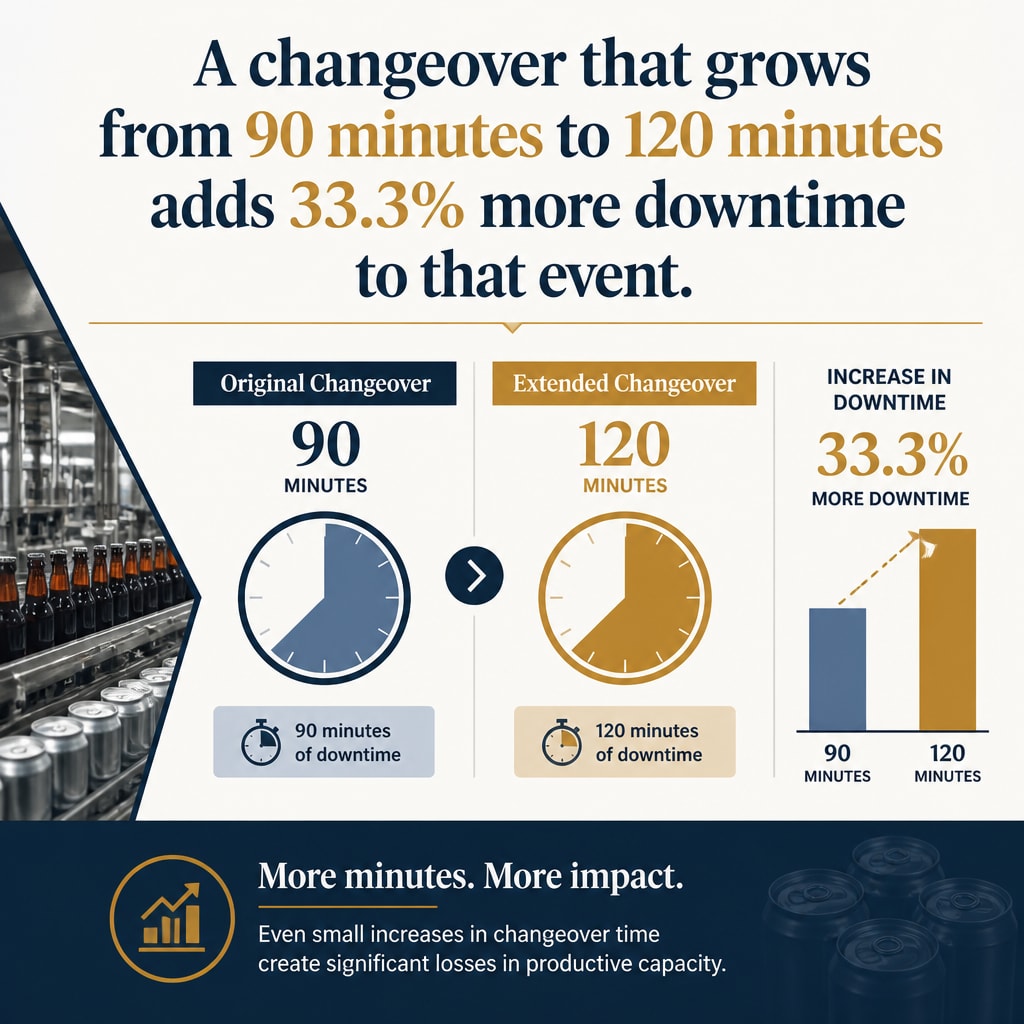
A changeover that grows from 90 minutes to 120 minutes adds 33.3% more downtime to that event. That extra half hour doesn’t stay on the production schedule. It pushes the next run, increases the chance of a late order, and makes the next planning decision more defensive.
Over time, your team stops trusting replenishment times. Sales asks for more finished goods. Purchasing orders earlier. Production runs larger batches than the demand really calls for. Cash begins to look scarce even while the warehouse is full.
The buffer is protection, but it is not free
In DBR, the Buffer protects customer orders from interruptions at the Drum. That idea is sound. A plant needs some protection. Production has too many variables to pretend every run will go perfectly.
The trouble starts when the Buffer becomes a substitute for reliability.
When changeovers are slow, people compensate with inventory. They produce more of one product before cleaning the line. They hold extra cans, bottles, caps, labels, concentrate, and finished cases. This may keep the line looking productive, but it also freezes cash in places that don’t pay a bill and the customer isn’t paying for.
I see this often with fast-moving seasonal products. A founder knows the summer window is short, so the plant builds far ahead. Some of that stock is sensible. Some of it exists because nobody believes the line can replenish the product quickly enough. The warehouse becomes an insurance policy against the plant’s own setup times.
Cutting a four-hour changeover to two hours reduces that event’s downtime by 50%, before any improvement in crew consistency or first-run quality is counted. That calculation matters because every recovered hour gives the Drum another chance to produce what customers actually need, rather than what the forecast guessed several weeks earlier.
There is a financial question hiding inside every buffer decision: how much stock would you need if the line could replenish reliably? Most teams never ask it. They debate inventory targets instead. The target rises, then rises again after one bad service failure.
The Rope keeps the plant from outrunning the constraint
The Rope is the release signal. It connects material starts and upstream work to the pace of the Drum. Its job is to prevent the rest of the plant from making more work than the constrained resource can handle.
This sounds straightforward. On the floor, it can feel uncomfortable.
A blending area may be capable of preparing far more product than the filler can package. A label supplier may deliver early, so the warehouse accepts the material even though the next run is not scheduled. A planner may release another work order because the line is down and people are worried about keeping everyone busy.
That creates a familiar mess: work in process grows, priorities change hourly, and operators get blamed for missing schedules they never had a fair chance to meet. The Rope is a discipline against that behavior. Production starts because the Drum needs the work, not because an upstream department has spare capacity.
For a CEO, this is less about adding control and more about removing false activity. A busy plant is not necessarily a healthy plant. What matters is whether the plant is producing the right product at a dependable pace, with enough protection to serve customers but not so much that cash disappears into storage.
Where beverage CEOs should look first
When working with clients on this, I don’t start by asking for a full inventory report. I start with the line that causes the most arguments.
Find the line everyone plans around
Which asset gets the most attention when it stops? Which line has orders waiting in front of it? Which machine forces the team to build large batches? That is often your Drum.
Don’t assume it’s the most expensive machine or the one with the highest theoretical speed. A modest packaging line can be the real constraint because it handles the product mix customers actually buy.
Separate scheduled time from usable time
Ask how much time the line is available for production, then subtract sanitation, changeovers, inspections, minor stops, and waiting for materials. Most plants track some of this data, but not always in a way that exposes the repeated pattern.
Pay close attention to the gap between the planned changeover and the actual changeover. That gap is often where the working capital problem begins.
Trace one SKU back to its cash
Pick a product that regularly runs late or gets built in large batches. Follow its ingredients, packaging, production slot, finished inventory, and shipment. You may find that the company holds three weeks of packaging to protect a run that should need only a few days of cover.
That exercise also helps you avoid a common mistake: treating all inventory as equally useful. A pallet of standard cans may support several products. A custom printed label for a slow-moving seasonal item is a different financial risk.
What a better DBR system changes
DBR does not ask you to eliminate every buffer. That would be reckless in any manufacturing plant. It asks you to size protection around the actual pace of the constraint and to release work according to that pace.
The practical target is steadier replenishment. Shorter setup windows help because the Drum becomes available more often. Better setup preparation helps too. Materials can be staged before the line stops. Tools and change parts can be ready. Quality checks can happen in parallel where the process allows it. The crew can record the true sequence instead of relying on memory and heroic effort.
None of this means every facility will cut changeover time in half. Product complexity, sanitation rules, allergen controls, and packaging variation matter. A high-acid product and an allergen-containing formula may require very different cleaning decisions. The point is to make the constraint’s lost time visible, then work on the causes that can actually be changed.
Once replenishment becomes faster and more dependable, the Buffer can come down with less risk. Not overnight. I prefer reducing it in measured steps, watching service performance and the Drum’s recovery at the same time.
This is the practical side of Drum-Buffer-Rope from the Theory of Constraints. The method connects the physical flow of product to the financial flow of cash. That connection is what makes it useful in an executive meeting.
How software fits into the decision
AI Tools and Software can help, but it won’t fix a line that nobody has defined correctly. The system should show actual changeover duration, constraint downtime, buffer levels, production sequence, and order risk. It should make exceptions easier to see.
Be cautious with dashboards that report dozens of measures while hiding the one line that controls throughput. I would rather have a plain screen showing the Drum, its next required product, the available buffer, and the reason for lost time than a polished report nobody uses during a morning meeting.
Good software supports the conversation. It doesn’t replace the conversation. Your plant manager and line supervisors still know details the data may miss, especially around sanitation, material shortages, and quality holds.
Start with the cash trapped by one constraint
When a beverage business feels cash-starved, the instinct is often to negotiate supplier terms, delay hiring, or push sales harder. Those actions may help. They don’t address inventory created by unreliable replenishment.
Find the Drum. Measure the lost time around its changeovers. Trace the Buffer back to the service problem it is meant to prevent. Then use the Rope to stop upstream production from getting ahead of reality.
I recommend starting with one line and one product family, not the whole factory. In a private 20-minute Working Capital Briefing, I can map the line dynamics on a digital whiteboard and show where the buffer is protecting orders, where it is simply hiding delay, and what the financial recovery might look like.
The takeaway
Your warehouse may be carrying the cost of a production problem that lives at the line. Long changeovers slow the Drum. Slow replenishment inflates the Buffer. Uncontrolled releases keep adding work that the constraint cannot finish.
Shorter, more dependable setup windows change that pattern. The line produces at a steadier pace, required stock can fall over time, and cash no longer has to do all the protecting.

